InquirySpec - Narrative Arc: Show how support fields route burden without centralizing coercive command. - Paradigm Shift: The reader shifts from hierarchy as default coordination to scaffolded autonomy with explicit state and artifact boundaries. - Reader Exit State: The reader can distinguish operational support from command capture.
The usual story about coordination is that someone needs to be in charge.
That story is not entirely wrong. Work does need authority. It needs decisions, boundaries, routing, review, memory, and closure. The mistake is assuming those functions must all appear as a command chain. When the only available structure is hierarchy, every coordination problem starts to look like a management problem. Someone has to remember the state. Someone has to interpret the rules. Someone has to decide which artifact counts. Someone has to push the work forward. Someone has to absorb the ambiguity and make the system move.
That "someone" might be a manager, a team lead, a subject-matter expert, a project owner, or, in the newer version of the same fantasy, an AI agent. The name changes. The burden remains.
The Field Guide is trying to draw a cleaner distinction. The opposite of unsupported autonomy is not command. The opposite of unsupported autonomy is a scaffold.
A scaffold is a structure that carries load without claiming to be the worker. It does not replace judgment. It does not become the source of authority by existing. It does not make every action safe. It gives bounded actors a way to act without being forced to impersonate the whole system.
That distinction matters because complex human-AI work is full of burdens that are real, necessary, and badly assigned. Someone has to maintain state. Someone or something has to preserve memory. Rules have to be applied. Inputs have to be routed. Outputs have to be reviewed before they travel. Evidence has to survive long enough for later repair. These are not minor administrative details. They are the conditions under which action becomes accountable.
When those conditions are not designed into the environment, they do not disappear. They migrate into people.
A person carries the missing state in their head. A team carries the missing memory in meetings. A model is asked to infer the missing process from a prompt. A manager becomes the de facto policy engine because no other boundary is visible. A dashboard becomes the shared account of the situation because the richer context has nowhere to live. The system may still look organized, but the organization is being purchased by overloading a few actors.
That is how command chains become attractive. Not always because people want coercion. Often because the alternative is an unstructured fog of partial records, urgency, and invisible context debt.
The command chain says: send it upward. Ask the lead. Escalate to the owner. Let the executive decide. Put the model in charge. Give the tool the whole task. Force the uncertainty into a single accountable surface.
It is efficient in the short term. It is costly over time.
The Burden Problem
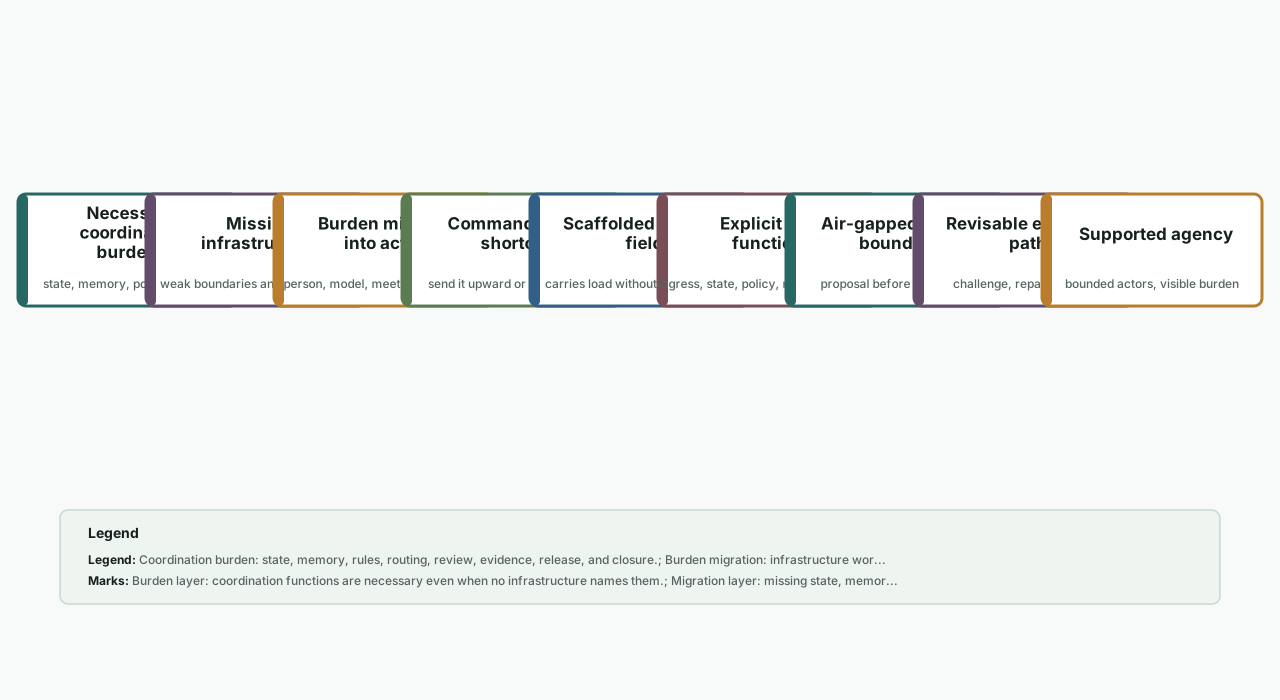
The problem with command chains is not that authority exists. The problem is that authority gets used as a substitute for missing infrastructure.
Imagine a team reviewing an AI-generated proposal. The proposal is fluent. It references the right project names. It seems to understand the objective. The meeting is already running long. A decision is needed. In a weakly scaffolded environment, the group asks a familiar but dangerous question: "Who can approve this?"
That question is sometimes necessary. But it is not sufficient.
The better questions are more structural. What entered the model? What state did the proposal assume? Which policy or standard applies? Which evidence is preserved? What does the proposal change if accepted? What is allowed to leave this review field? What would let the team repair the decision later?
Those questions are not trying to remove authority. They are trying to make authority usable. A person cannot responsibly approve what the environment cannot help them inspect.
This is the central move of Supported Agency. The actor remains real. The judgment remains local. But the environment carries the burdens that should not be loaded into one mind, one thread, one model, or one role. Routing, state, memory, governance, verification, and release become field functions rather than heroic personal obligations.
The result is not less agency. It is less impersonation.
The person no longer has to impersonate a database. The AI system no longer has to impersonate a project owner. The manager no longer has to impersonate the entire policy layer. The meeting no longer has to impersonate institutional memory. The artifact no longer has to impersonate the situation that produced it.
The scaffold gives each actor a smaller and more honest job.
What a Scaffold Carries
A scaffold carries burdens that are easy to underestimate because they often look like background work.
It carries ingress: what is allowed to enter the work, in what form, with what identity and context. It carries state: where the work currently is, what has already been decided, what remains provisional. It carries policy: which standards, constraints, and closure rules apply. It carries memory: which prior artifacts, records, and traces matter for this action. It carries execution routing: what kind of step is being taken and who or what is fit to take it. It carries output boundaries: what can be released, to whom, under what conditions.
This is the human-facing version of the service separation described by the Workflow Engine. The point is not to make the reader memorize internal machinery. The point is to notice a practical pattern: when coordination functions are separated and visible, work does not have to become a command chain merely to remain coherent.
In a command chain, the person at the top often becomes the place where missing structure is resolved. In a scaffolded field, the structure is distributed into artifacts, protocols, ledgers, review gates, and explicit handoffs.
That distribution changes the texture of work.
A draft can be useful without being authoritative. A model output can be considered without being obeyed. A metric can trigger inquiry without becoming a verdict. A team member can make a local decision without pretending to own all downstream consequences. A reviewer can authorize release because the relevant context, constraints, and evidence have been made available at the boundary where release happens.
This is not bureaucracy for its own sake. It is how fast work avoids becoming unreviewable work.
The Air Gap Is a Human Courtesy
The phrase air-gapped can sound severe, as if the system is mainly concerned with isolation. In this Field Guide, the more important meaning is a governed transfer boundary.
An Air-Gapped Support Field gives work a place to be provisional. A proposal can exist without immediately changing the shared world. A branch can contain a possible implementation without becoming the main state. A model can generate options without silently becoming the decision-maker. A human can review, adapt, veto, or release without having to reconstruct the whole path from memory.
That pause is not anti-human. It is a courtesy to human judgment.
Without the pause, speed becomes pressure. The artifact that travels fastest becomes the artifact that governs. The spreadsheet is treated as the account. The summary becomes the memory. The plan becomes the mandate. The model response becomes the next action because it is already there, already formatted, already plausible.
The air gap interrupts that drift. It says: this artifact may be useful, but it has not yet crossed the boundary. It still needs the right review, the right evidence, the right state, the right release conditions.
That boundary protects people from two equal failures. It protects them from being bypassed by fluent artifacts. It also protects them from being overloaded by responsibilities that should have been externalized into the field.
Scaffolds Must Remain Revisable
A scaffold is not a finished answer. It is a provisional structure for carrying work under known constraints.
This matters because any support structure can harden into command if it forgets its own limits. A checklist can become ritual. A workflow can become theater. A dashboard can become a verdict. A policy gate can become a place where nobody is allowed to notice the actual situation.
The boundary method behind the Field Guide gives a useful discipline here: define the edge of the work, make the working model usable, and keep a pathway for incompleteness. In ordinary language, a scaffold must say what it is holding, what it is not holding, how it can fail, and how it can be revised.
If a scaffold cannot be challenged, it is becoming a command chain.
If a scaffold cannot preserve evidence, it is becoming a performance surface.
If a scaffold cannot distinguish routine work from high-risk work, it is becoming a blunt instrument.
If a scaffold cannot explain what conditions allow release, it is becoming a hidden authority layer.
The purpose of a scaffold is not to remove friction. Some friction is protective. The purpose is to move friction to the place where it can do useful work: at the boundary between proposal and promotion, between signal and decision, between local action and shared consequence.
The Practical Test
You can test whether a work system is acting like a scaffold or a command chain by asking four questions.
First: what burden is being carried?
If a person is being asked to remember everything, reconcile every artifact, infer every policy, and validate every output, the system is not supporting agency. It is outsourcing infrastructure to a human nervous system.
Second: what boundary is explicit?
If there is no clear distinction between draft and decision, proposal and release, local artifact and shared state, then authority will attach to whatever artifact moves fastest.
Third: what evidence survives?
If later repair depends on memory, reputation, or persuasion, the system has not preserved enough trace. Reviewable work needs durable artifacts: assumptions, inputs, decisions, tests, constraints, approvals, refusals, and release conditions at the right fidelity.
Fourth: what can be revised?
If the workflow cannot admit anomaly or update its own structure, it is not a scaffold. It is a frozen route. Real work changes the model that supports it.
These questions are not a full methodology. They are a reader's first handle. They help distinguish operational support from command capture.
The Shift
The shift from command chains to scaffolds is not a rejection of authority. It is a relocation of burden.
Authority still matters. Judgment still matters. Accountability still matters. But the Field Guide refuses the lazy version of coordination where authority is forced to compensate for missing state, missing memory, missing review, missing policy, or missing release boundaries.
A scaffolded system asks less theatrical questions.
It asks where the work is. It asks what has been preserved. It asks what is authorized. It asks which boundary the artifact is approaching. It asks whether the actor is being supported or overloaded. It asks whether the structure can learn from what it fails to hold.
That is the practical promise of Season 4. Human-AI work does not need a bigger command chain. It needs better fields of support: bounded enough to guide action, open enough to be corrected, and explicit enough that people can tell when help has quietly become control.