InquirySpec - Ontological Boundary: An Air-Gapped Support Field is a bounded scaffold that supports action without absorbing all agency into one command surface. - Not This: Not isolation for secrecy alone or a magical safety guarantee. - Doctrine Dependencies: Workflow Engine, lC.Core.
Working Definition
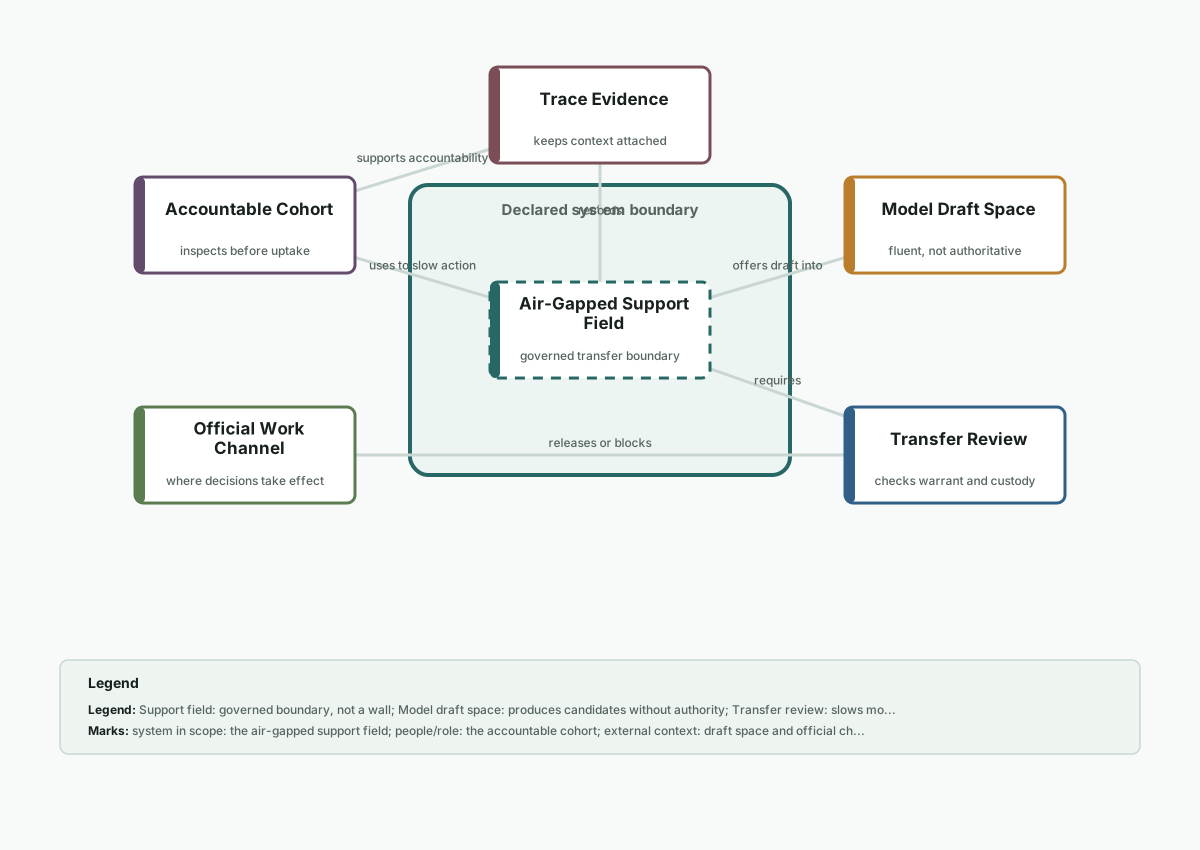
An Air-Gapped Support Field is a bounded environment where work can be generated, held, reviewed, routed, verified, and released without letting any single actor silently absorb the whole workflow.
The air gap is not primarily a wall. It is a governed transfer boundary. A draft can be produced inside one bounded space, but it cannot become authoritative merely because it is fluent, fast, or convenient. A model can propose. A person can judge. A tool can execute. A ledger can preserve evidence. The support field keeps those capacities adjacent without pretending they are the same capacity.
In the Field Guide, the concept matters because accountable human-AI work needs places where action can slow down just enough to become inspectable. The support field gives a cohort a way to ask: What entered the work? What state did it carry? What rules or constraints applied? What evidence survived? Who or what reviewed it? What conditions allow it to leave this bounded space?
Those are not philosophical luxuries. They are operational boundaries for work that can affect people, systems, budgets, records, code, policy, and institutional memory.
The Phenomenological Problem
The common failure mode of digital coordination is premature promotion.
A status summary becomes a decision. A model response becomes a plan. A metric becomes a story about performance. A draft becomes an official position because it is the most visible artifact in the channel. The movement is usually not malicious. It is systemic gravity. Work is urgent, attention is scarce, and maintaining context has a metabolic tax. The system rewards the artifact that can travel fastest.
When there is no support field, actors are forced to carry burdens that belong to the environment. A person has to remember which record is current, whether the model had enough context, which policy is relevant, who has authority to release, and what evidence would make the action reviewable later. An AI system is asked to plan, remember, govern, and verify inside one continuous surface. A temporary group tries to coordinate through chat, files, and meetings while the structure that should preserve state remains implicit.
The result is not merely confusion. It is unscaffolded disingenuity: well-meaning people begin relying on whatever flattened artifact keeps the work moving because the system gives them no better way to preserve the richer situation. The support field exists to reduce that pressure. It does not remove judgment. It gives judgment a bounded place to operate.
The Engineering Anchor
Internally, this node is anchored in the Workflow Engine doctrine and the common core doctrine.
The Workflow Engine doctrine defines air-gapped synthesis as a separation between generation and authoritative promotion. A branch, draft, trace, or proposal can be produced inside an isolated work space, but persistent state is changed only through an explicit integration boundary. That boundary requires validation, review, and controlled release. The point is not secrecy. The point is that generated work should not mutate the shared world before the system can assess what happened.
The same doctrine also names Supported Agency as the alternative to monolithic burden. Humans and machines should not be treated as all-purpose sovereign operators. The support field carries state orientation, process routing, memory access, governance, verification, escalation, traceability, and egress conditions so bounded actors can spend their limited attention on situated judgment.
The common core doctrine gives the support field its coordination grammar. Input, state, policy, memory, execution, and output are separate responsibilities. Publicly, that means a support field should make it possible to distinguish what was received, what condition it entered, which rule applies, what memory is authorized, what action is being attempted, and what output is eligible to leave the field.
That is why an Air-Gapped Support Field is closely related to the Workflow Engine. The engine coordinates the movement of work. The support field is the bounded environment in which that movement becomes inspectable before it becomes consequential.
Boundary Conditions
An Air-Gapped Support Field is this:
- A bounded coordination environment for humans, AI systems, records, tools, branches, ledgers, and review practices.
- A staged transfer boundary between proposal and promotion.
- A way to preserve enough evidence that work can be inspected, challenged, replayed, paused, repaired, or released.
- A scaffold that protects local judgment by externalizing state, routing, governance, and verification load.
- A practical field for Transitory Cohorts that need accountable coordination without becoming permanent command structures.
It is not this:
- Isolation for secrecy alone.
- A guarantee that work is safe because it was separated.
- A hidden command center that decides for everyone.
- A claim that every intermediate trace must be exposed to every participant at all times.
- A way to remove human responsibility by routing everything through tooling.
The boundary standard is assessability. A support field is working when the movement from input to output can be reconstructed well enough to ask whether the right context, constraints, review, and authority were present at the point of release.
Drill Path
Start with Supported Agency to understand why the Field Guide does not place the whole burden of work on a single person, model, role, or command surface.
Then read Workflow Engine to see how coordination, memory, policy, state, execution, and release are separated into a repeatable work system.
Finally, connect this node to Transitory Cohorts. Temporary groups need support fields because they often lack stable institutional memory, durable role boundaries, and shared review rituals. The air-gapped field gives them a way to work together without pretending the chat thread, meeting note, model output, or dashboard is the whole situation.