InquirySpec - Narrative Arc: Challenge autonomous-agent hype and the homunculus fallacy directly. - Paradigm Shift: The reader understands that learnt.cloud relieves agents of routing and governance burdens rather than pretending to create god-like autonomy. - Reader Exit State: The reader can explain supported agency over monolithic burden.
The Seduction of One Actor
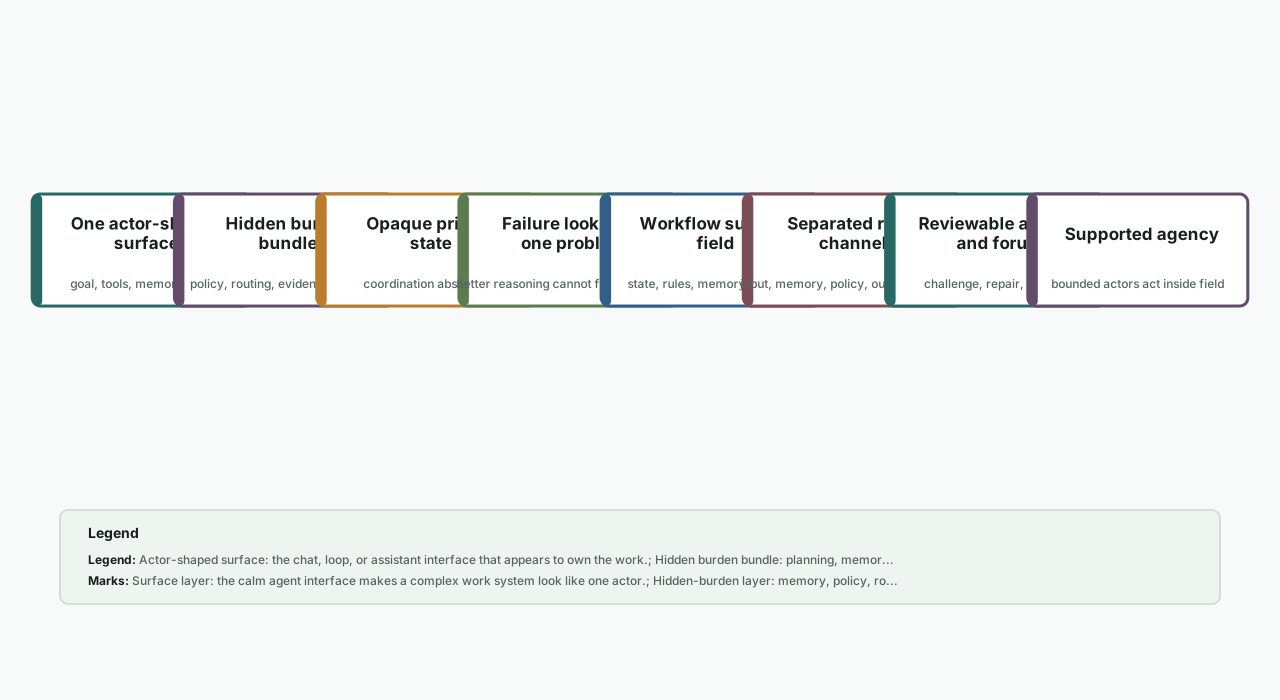
The autonomous agent is a clean story.
Give it a goal. Let it plan. Let it call tools. Let it remember what happened. Let it decide the next step. Let it evaluate its own result. Let it keep going until the work is done.
On a demo screen, this feels almost irresistible. The interface is calm. The sequence is legible. A human writes one request, and the machine appears to transform intent into action. Compared with the ordinary mess of knowledge work, the promise is obvious. Nobody wants another handoff. Nobody wants another status meeting. Nobody wants to carry the same context across five tabs, three tools, two teams, and a policy document that nobody has read since last quarter.
So the autonomous agent becomes a container for hope. It seems to offer a way around the metabolic tax of coordination. Instead of designing the work field, we can point one agent at the work and let it absorb the complexity.
That is the mistake.
The issue is not that AI systems should avoid action. It is not that tool use is bad, planning is fake, or automation has no place in serious work. The issue is that the word "agent" can hide an entire architecture. It can make one actor-shaped surface appear to contain planning, memory, policy, routing, execution, evidence, verification, release, and consequence.
That bundle is the Monolithic Agent Fallacy. It is the belief that the work system can be compressed into one fluent actor.
The Burden Does Not Disappear
The burden does not disappear when the interface becomes simple. It moves.
A model can summarize a meeting, but the summary still depends on which meeting mattered, which voices were absent, which prior commitments constrained the decision, and what authority the summary is allowed to carry. A tool call can update a ticket, but the update still depends on whether the ticket was the right artifact, whether the state was current, whether the action was authorized, and whether someone can inspect what changed later. A planning loop can produce a sequence of steps, but the plan still depends on the boundary of the task, the risks of the environment, the memory being used, and the criteria for stopping.
If the surrounding system does not preserve those conditions, the agent is not solving coordination. It is absorbing coordination into private state.
That private state may look competent. It may be fluent. It may produce an artifact that satisfies the immediate request. Under pressure, that is enough to keep work moving. But the same pressure is exactly why the design is fragile. Systemic gravity rewards whatever reduces visible friction right now. A single agent loop reduces visible friction by hiding the distinctions that later become consequential.
Who authorized this action?
Which memory was used?
What policy boundary applied?
What evidence survived?
What was merely suggested, and what was actually released?
If those questions have no structural answer, the agent is carrying burdens that belong to the field.
Support Is Not Weakness
The alternative is not smaller ambition. It is better burden placement.
Supported Agency begins from a simple premise: bounded actors can act well when the field around them carries the right supports. A person can apply judgment without remembering the whole organization. A team can coordinate without pretending every participant has the same context. An AI system can generate, transform, route, or inspect artifacts without being treated as the owner of the entire work boundary.
Support does not remove agency. It protects agency from overload.
In ordinary work, we already know this. A surgeon does not become less skilled because the operating room has sterile procedure, checklists, role boundaries, monitoring equipment, and a record of what happened. A pilot does not become less responsible because the cockpit contains instruments and air traffic coordination. A researcher does not become less thoughtful because the lab notebook, peer review, and method section preserve context outside private memory.
The same principle applies to human-AI work. The goal is not to create a god-like actor. The goal is to create a field where many bounded actors can participate without each one pretending to be the whole system.
That field has to carry several burdens explicitly.
It needs input boundaries, so the system can tell what entered the workstream. It needs state, so the actor knows where the work currently sits. It needs memory, so prior context can be retrieved without becoming rumor. It needs policy, so action is constrained by declared rules rather than mood, fluency, or convenience. It needs execution routing, so different kinds of work go through different paths. It needs output boundaries, so release is controlled rather than assumed. It needs evidence, so review can happen after the fact.
When those burdens are visible, an AI agent can be useful without becoming mythological.
The Interface Is Not the System
The most dangerous feature of a monolithic agent is that it makes the interface feel like the system.
A chat window can feel like a worker. A task loop can feel like a project manager. A memory summary can feel like institutional continuity. A tool log can feel like accountability. But each of these is only a surface unless the surrounding structure makes it reviewable.
This is where the Workflow Engine becomes necessary. It is not a larger agent. It is not a command hierarchy hiding behind softer language. It is a coordination layer that keeps intent, state, policy, memory, tools, evidence, review, and release from being fused into one opaque actor.
That separation matters because different failures require different repairs.
If the input was wrong, better model reasoning will not fix the boundary. If the memory was unauthorized, a more persuasive answer only deepens the problem. If the policy was unclear, tool success is not enough. If the output was released too early, local cleverness becomes systemic risk. If the evidence trail is missing, nobody can responsibly learn from the event.
The monolithic agent hides these differences. The support field keeps them available for inspection.
Accountability Is Not a Tool Call
There is another temptation here. Once the system records enough traces, people may start treating the machine record as accountability itself.
That is also wrong.
A record can show what happened inside the system. It can preserve a sequence, protect against revisionism, and make later assessment possible. But the record is not a human forum. It does not understand the social weight of a consequence. It does not repair damaged trust. It does not decide what a community should value. It does not absolve an actor because the actor followed a workflow.
Accountable work needs evidence and interpretation. Evidence without dialogue becomes surveillance theater. Dialogue without evidence becomes performance. A supported field must therefore preserve reviewable artifacts while leaving room for human judgment, challenge, repair, and refusal.
This is where autonomous-agent hype often becomes too thin. It asks whether the agent can complete the task. That is not enough. Serious work has a harder question: can the action be situated, challenged, repaired, and learned from?
If the answer is no, then the task was not really completed. It merely moved.
A Better Test
The practical test is not "Can an agent do this?"
The better test is: what burden is being assigned to the actor?
If the actor is expected to remember the project, infer the rules, choose the tool, route the artifact, verify the result, update the record, interpret the consequence, and decide when the work is done, the design is drifting toward monolithic burden.
If the actor operates inside a field where those burdens are distributed, named, and reviewable, the design is moving toward supported agency.
Ask these questions before trusting the agent-shaped surface:
- What context must travel with the work?
- What memory is authorized, and who can inspect it?
- What rules govern the next action?
- What artifact will survive for review?
- What kind of judgment remains local to the actor?
- What consequence returns if the action harms the workstream?
- What stops the system from treating fluency as closure?
These questions are not anti-innovation. They are how innovation survives contact with real work.
Against the Shortcut
The monolithic agent is a shortcut around the hard part of coordination. It says: let one actor hold the situation.
The Field Guide takes the opposite position. Do not ask one actor to hold the situation. Build the situation so bounded actors can work inside it.
That means some of the most important AI infrastructure will not look glamorous. It will look like state records, routing rules, archives, ledgers, review boundaries, versioned artifacts, evidence packets, and careful handoffs. It will look less like a magical employee and more like an operating environment for accountable work.
That may seem less exciting than a fully autonomous assistant. It is also more honest about what complex work requires.
When the burden is placed correctly, humans do not have to pretend they remember everything. AI systems do not have to pretend they own the workflow. Teams do not have to pretend that a smooth interface has resolved their coordination problem.
The work can move, but it can also be inspected.
The actor can act, but the field carries what the actor should not have to carry alone.
That is the shift from monolithic agency to supported agency. It is not a smaller dream. It is a more durable one.