InquirySpec - Narrative Arc: Return from tooling to the sociological problem: performative compliance and cognitive dissonance inside coercive digital-organizational apparatuses. - Paradigm Shift: The reader sees learnt.cloud as tooling for structural escape from apparatus pressure, not as a philosophy of salvation. - Reader Exit State: The reader can name how groups can route reality-contact around systems that reward performance over correction.
The apparatus is not a machine in the corner. It is the social machinery that teaches people which performances are safe.
It can look like a dashboard meeting where everyone knows the metric is too thin, but the metric is the only artifact allowed to matter. It can look like a public consultation where feedback is collected, summarized, and neutralized before it can change the route of work. It can look like a research review where anomalies are welcomed as long as they do not threaten the preferred frame. It can look like a team saying the required words while quietly carrying the consequences that the official record cannot metabolize.
This is not usually sustained by dramatic bad intent. It is sustained by systemic gravity. Context is expensive. Participation is slow. Repair changes who has to carry burden. Evidence can implicate routines that the institution depends on. Under pressure, the system begins to prefer what is easy to process: clean metrics, stable stories, managed disagreement, and records that preserve the appearance of order.
The result is not simply ignorance. It is a patterned split between what the system can say and what the situation keeps showing. People learn to produce coherence for the apparatus while privately adapting to the consequences the apparatus cannot name. That is the cultural gravity well this Field Guide has been moving toward.
The Apparatus Does Not Need Belief
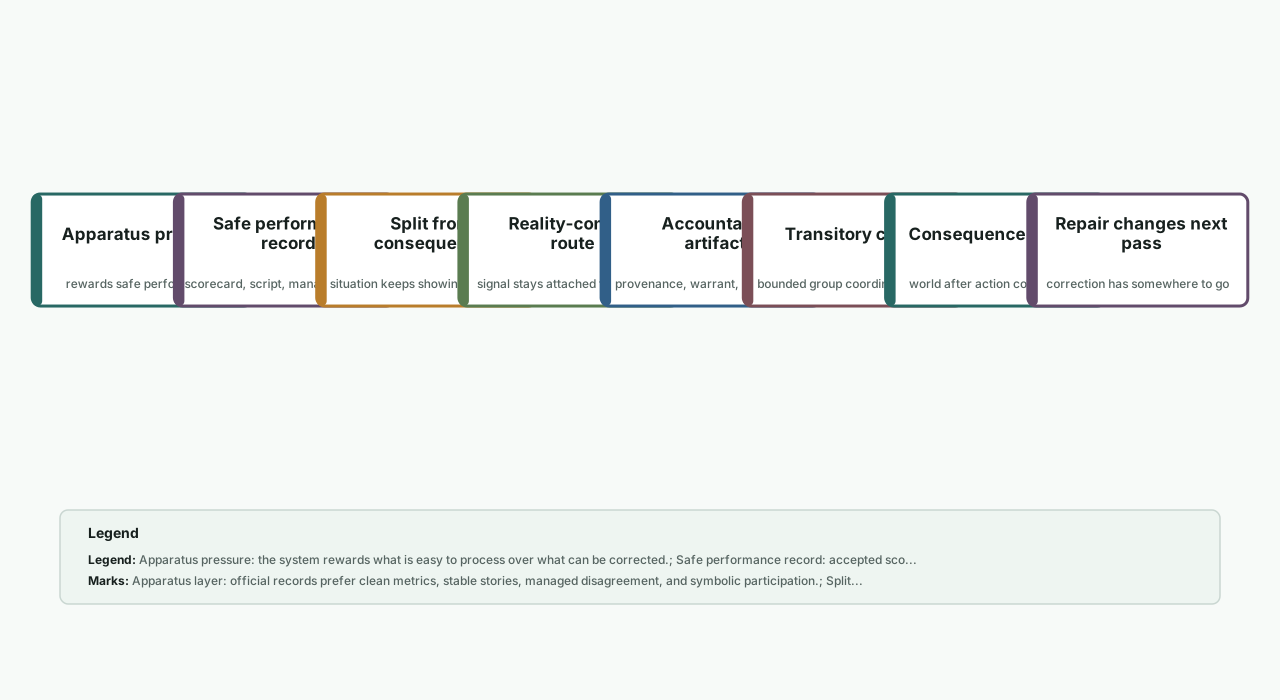
An apparatus does not need everyone to believe its story. It only needs enough people to behave as if the story is operationally mandatory.
The meeting proceeds. The scorecard is accepted. The compliance language is repeated. The dissent is thanked and routed into a nonbinding channel. The exception is treated as anecdote. The unresolved burden is carried by whoever has the least ability to stop carrying it. The record looks complete because the system has recorded the parts it knows how to process.
This is why the apparatus is so difficult to escape. It rarely announces itself as oppression. It often presents itself as continuity, professionalism, risk management, alignment, efficiency, or care. Some of those aims can be legitimate. A group does need shared language, repeatable procedures, and records that travel. The problem begins when those forms protect the appearance of coherence more than they protect contact with consequence.
The important distinction is practical. A healthy structure makes consequences more legible, evidence more inspectable, and repair more possible. Apparatus pressure makes consequences harder to return to their causes, evidence easier to flatten, and participation safer when it remains symbolic.
That is the pattern named by Ideology-as-Apparatus. It is not a partisan label. It is a diagnostic for the moment when a system rewards performance over correction.
Why Exit Is Not Enough
There is a tempting story about escape: leave the institution, reject the script, refuse the role, step outside the maze.
Sometimes exit is necessary. Some environments punish participation so consistently that leaving is the most responsible move available. But exit alone is not the method this Field Guide is trying to build. A person can leave an organization and still carry its value reflexes. A team can rebrand itself and still reproduce the same burden distribution. A tool can replace an old workflow and still preserve the same apparatus logic under a cleaner interface.
The deeper question is not, "How do we get away from the label?" The deeper question is, "What routes would let people keep reality-contact when the surrounding system rewards performance?"
That question changes the shape of escape. Escape becomes less like a dramatic departure and more like a structural rerouting. It asks where consequence can travel without being hidden. It asks what evidence can survive handoff without becoming surveillance. It asks where affected people can interpret the record instead of merely being recorded by it. It asks how a group can act without waiting for the entire institution to become coherent.
The apparatus is escaped in patches, routes, practices, and artifacts. It is escaped whenever a group preserves the conditions under which correction can happen.
The First Route Is Contact
The first escape route is Reality-Contact.
Reality-contact is not certainty. It is the maintained relation among signal, situation, artifact, action, consequence, and repair capacity. A dashboard tile has contact when the group can still inspect what produced the number, what the number can responsibly support, and what consequence followed from acting on it. A model output has contact when the group can see what context entered the system, what uncertainty remains, and what human judgment is required before the output changes anything. A policy note has contact when affected people can challenge its assumptions through a forum that can actually alter the route of work.
The apparatus breaks contact by turning portable artifacts into self-contained authority. The number becomes the situation. The summary becomes the understanding. The record becomes the accountability. The role script becomes the response.
Reality-contact reverses that movement. It asks the artifact to keep its attachments visible. What was observed? What context traveled with it? What interpretation was made? What action followed? What came back from the world after action? What remains open to repair?
Those questions are not ornamental. They are the minimum conditions for a group to stop performing coherence and start coordinating around what is actually happening.
The Second Route Is Artifact Discipline
The second escape route is the accountable artifact.
An accountable artifact is not simply a good document. It is a record that carries enough provenance, warrant, uncertainty, responsibility, and correction route to survive handoff. It does not merely look official. It lets the next competent person ask: where did this come from, what does it claim, what can it support, who or what is affected, and how can it be revised if contact with consequence exposes a problem?
Apparatus systems love artifacts that close inquiry too early. The final deck. The official memo. The scorecard. The executive summary. The generated report. These can be useful, but they become apparatus-bearing when they make the underlying situation harder to inspect.
The escape route is not to abandon artifacts. It is to build better ones. A useful artifact can say, "This is the current interpretation, not the whole situation." It can preserve dissent without turning dissent into decoration. It can name unresolved questions. It can distinguish evidence from judgment. It can leave a repair route visible.
This matters especially in human-AI work. A model can produce a fluent artifact faster than a group can establish whether the artifact has contact. The answer is not to reject fluency. The answer is to prevent fluency from becoming promotion. The artifact should remain provisional until it has passed through evidence, forum, and consequence checks.
The Third Route Is The Temporary Group
The third escape route is the Transitory Cohort.
Large systems often make repair wait for permanent structure. A department must own it. A committee must be formed. A governance process must be invoked. Sometimes that is necessary. Often it is too slow, too narrow, or too committed to preserving the same apparatus route that created the problem.
A transitory cohort is a temporary, purpose-bounded group that forms around a concrete work situation. It does not need to become a permanent organization. Its continuity comes from shared artifacts, review boundaries, evidence trails, role expectations, and release conditions.
This is one of the most practical forms of escape because it lets people coordinate before the institution is ready to redesign itself. A cohort can gather the signal, preserve context, interpret the burden, create an accountable artifact, and hand off a repair route. It can work inside a larger system without pretending the larger system has already become structurally coherent.
The cohort is not a secret cell or informal workaround. It is accountable precisely because its work leaves a reviewable trail. It can dissolve only when the next responsible actor can understand what was done, what remains uncertain, what consequence was observed, and what repair path is still available.
Escape Is A Loop, Not A Pose
The practical movement is simple to state and hard to sustain.
Observe the signal without stripping away the situation. Interpret the signal without letting the preferred story absorb it. Apply a bounded move that can be inspected later. Then let the consequence of that move return to the next pass.
This loop is what separates escape from performance. A system can perform dissent. It can perform accountability. It can perform reform. It can perform care. The test is whether those performances change the routing of consequence, evidence, participation, and repair.
If nothing can come back from reality and alter the next action, the apparatus is still intact.
If a group can preserve contact, create accountable artifacts, and coordinate through a temporary cohort, then escape has already begun. Not as a final condition. Not as a philosophy of salvation. As a working route through which people can act without surrendering the situation to the performance demanded by the system around them.
That is the human purpose of the tooling underneath this Field Guide. The point is not infrastructure for its own sake. The point is to make accountable reality-contact structurally possible for groups that would otherwise be forced to choose between compliance theater and private exhaustion.
Escaping the apparatus begins when correction has somewhere to go.