InquirySpec - Narrative Arc: Explain how artifacts can carry responsibility, provenance, and correction across people without requiring coercive hierarchy. - Paradigm Shift: The reader learns that better tools do not merely store work; they change what kinds of collective action become possible. - Reader Exit State: The reader can describe the SAMR movement from substitution toward redefined collective capability.
Accountable Artifacts for Human Groups
Human groups do not fail only because they lack information. They fail because the information they have cannot carry enough responsibility across distance.
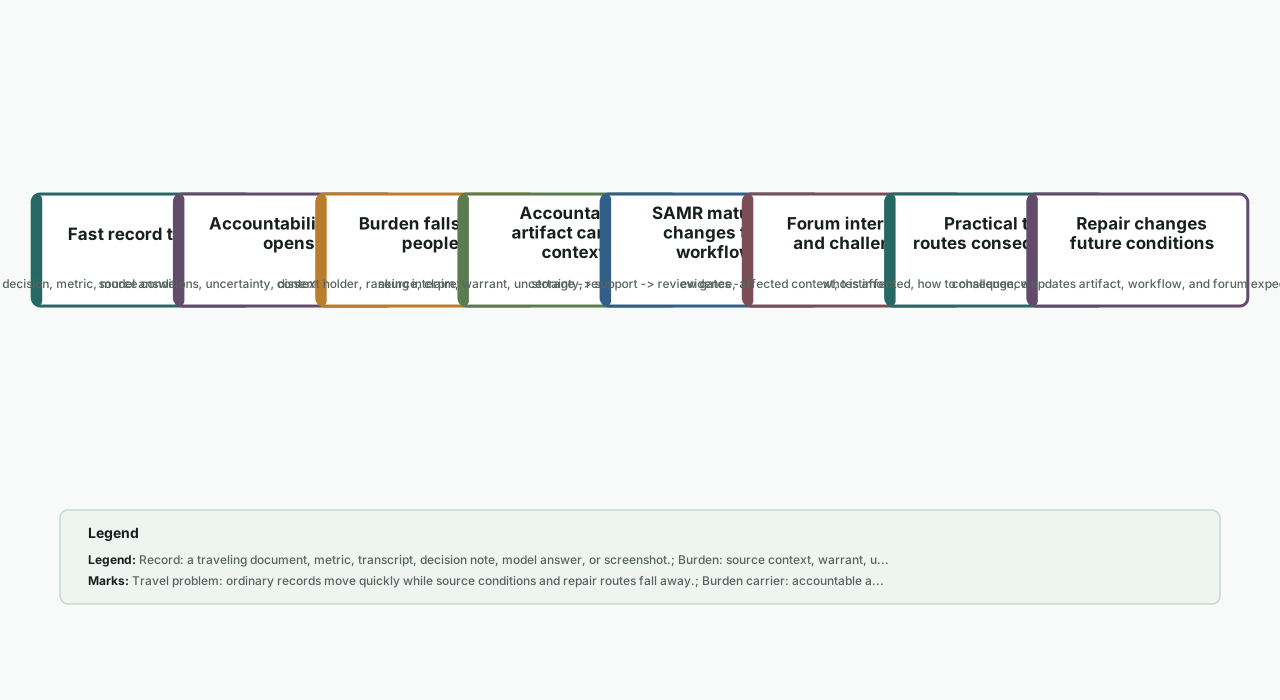
A decision leaves a meeting. A number leaves a dashboard. A model answer leaves the chat window. A screenshot leaves the situation that made it meaningful. Each fragment can travel quickly, but speed does not guarantee accountability. Once the fragment moves, people downstream may inherit the pressure to act without inheriting the source conditions, uncertainties, dissent, or repair route.
This is why an Accountable Artifact matters. It is not a better-looking document. It is a record built to survive handoff without pretending to be the whole situation.
The human problem is not that groups need more paperwork. They need artifacts that can carry enough contact with the work for people to coordinate without relying on private memory, informal status, or coercive hierarchy.
Documentation Is Not Accountability
Most institutions already produce documents. They have policies, dashboards, transcripts, reports, tickets, forms, slide decks, and meeting notes. The presence of those records can create the impression that the work is accountable. Something was written down. Someone approved it. A file exists.
But a file can exist while accountability remains almost impossible.
If a metric travels without the operating conditions that produced it, the receiving group may treat a signal as a verdict. If a meeting note records the decision but omits the unresolved uncertainty, dissent disappears from the official path. If a model output is pasted into a brief without its source packet, later readers cannot see what was observed, what was inferred, and what was skipped. If a policy review records compliance but not consequence, the system can appear orderly while repair remains unreachable.
This is not usually a drama of conscious deception. It is systemic gravity. Context is expensive to preserve. Everyone is tired. The organization rewards the artifact that looks complete enough to move. Under pressure, the system chooses the record that can pass through the next checkpoint, not necessarily the record that will help people understand what happened later.
Accountable artifacts resist that drift. They carry source, claim, warrant, uncertainty, responsibility, and correction route. They do not eliminate judgment. They make judgment less dependent on status and memory.
The Artifact Carries The Burden
Groups coordinate by moving burdens around. Someone has to remember why the decision was made. Someone has to know which source was used. Someone has to notice which assumption is still unresolved. Someone has to understand who can challenge the record. Someone has to carry the consequence when the earlier interpretation was incomplete.
When no artifact carries those burdens, people do.
That is how informal hierarchies harden. The person with the most context becomes indispensable. The person with the most authority decides what the record means. The person closest to the harm carries cleanup without a route for review. The person with the least power may be asked to accept the artifact as final because there is no stable way to contest it.
A better artifact changes the shape of the burden. It does not make the group frictionless. It gives the friction a place to go.
The source can be attached. The claim can be bounded. The uncertainty can remain visible. The status can be marked as draft, reviewed, disputed, superseded, or repaired. The people affected by the record can have a route to add context. The next person in the chain can see whether they are holding evidence, interpretation, proposal, decision, or instruction.
That distinction is quiet, but it is structural. A group that can distinguish evidence from interpretation is harder to coerce through ambiguity. A group that can preserve uncertainty is less likely to manufacture false confidence. A group that can route correction is less dependent on apology after damage has already spread.
The Four Movements
The SAMR lens helps name the difference between storing work and changing work.
At the substitution level, an old record moves into a digital form. A paper form becomes a web form. A whiteboard becomes a shared canvas. A spoken update becomes a written note. This can be useful. It is also easy to overestimate. Substitution makes the record easier to store and move, but it may leave the accountability pattern untouched.
At the augmentation level, the record gains support. Links, timestamps, authorship, version history, metadata, comments, and search make the artifact more usable. The artifact now carries more context than the old form could comfortably hold. Still, the surrounding workflow may remain mostly the same.
At the modification level, the artifact starts changing the workflow. Review status matters. Source packets become part of the handoff. A decision cannot be promoted without visible uncertainty or affected-party review. A model output is not treated as complete unless its source conditions and intended use are recorded. The group no longer relies only on memory and meeting authority.
At the redefinition level, new kinds of collective action become possible. A temporary group can coordinate across time zones because the artifact carries enough context for each person to enter the work responsibly. A human-AI workflow can be reviewed because prompts, sources, outputs, corrections, and consequences are not scattered across private surfaces. A community can resist apparatus pressure because the record does not force everyone to accept the official summary as the only available account.
That is the movement: from digital storage, to context support, to workflow change, to new collective capability.
Accountability Needs A Forum
An accountable artifact is not a courtroom. It does not decide guilt. It does not create repair by existing.
This matters because records can easily become instruments of control. A surveillance log can be precise and still unaccountable. A dashboard can be accurate and still unfairly interpreted. A transcript can be complete and still used to narrow the forum rather than open it.
Accountability Assessment keeps the distinction clear. Consequences, evidence, and forum quality have to remain separate enough to inspect. A record can preserve evidence, but people still need a legitimate forum to interpret it. A forum can hear testimony, but it needs evidence that has not been stripped of context. Repair can be named, but it needs a route that changes future conditions rather than merely restoring appearances.
The artifact serves the forum. It does not replace it.
That is why accountable artifacts are especially important for human groups that do not want to govern by hierarchy alone. If the only way to resolve ambiguity is to ask the ranking person what the record means, the artifact has failed to carry enough responsibility. If the only way to challenge a record is to risk social punishment, the artifact has failed to preserve a correction route. If the only way to know whether a decision was repaired is to trust somebody's memory, the artifact has failed to carry consequence back into the work.
The goal is not a perfect archive. The goal is enough assessability for people to act together without surrendering judgment to the loudest summary or the highest office.
The Practical Test
Before a group treats an artifact as accountable, it can ask a compact set of questions.
What situation produced this record? What claim does it actually support? What evidence is attached? What uncertainty remains visible? Who has responsibility for maintaining it? Who is affected by its use? How can it be challenged? What consequence should return to the artifact if the action based on it fails?
Those questions do not slow the work for their own sake. They prevent hidden delay from becoming visible damage later.
A group that asks those questions begins to change its operating conditions. It stops treating documentation as an administrative afterthought. It starts treating artifacts as part of the social machinery of coordination.
That is the public significance of the Field Guide's artifact discipline. A better record is not merely a cleaner container for information. It is a support field for human groups trying to act with contact, responsibility, and repair capacity under pressure.
The artifact does not save the group. It gives the group something sturdy enough to meet around, inspect, revise, and carry forward.