InquirySpec - Narrative Arc: Close the Field Guide by returning to human groups: the goal is augmented agency, structural coherence, and accountable reality-contact. - Paradigm Shift: The reader understands that the machine layer exists to help people act together with less dissonance, less coercion, and more repair capacity. - Reader Exit State: The reader exits with a practical image of transitory cohorts using cyber-physical scaffolds to do coherent work.
Augmented Agency
The point of the Field Guide is not a better machine.
The point is a better condition for human action.
A group should be able to face a complicated situation, preserve enough context to understand it, make a situated move, see what consequence returns, and repair the work without pretending that one person, one meeting, one metric, or one model response can carry the whole burden.
That condition is Augmented Agency.
The phrase can sound larger than it is. It does not mean superhuman autonomy. It does not mean that a tool makes judgment unnecessary. It does not mean that a central machine gets to decide what the group should do. It means that the work environment has been designed so people do not have to carry impossible coordination burdens inside private memory.
Agency is augmented when the surrounding structure helps people know what entered the work, what context traveled with it, what boundary applies, what evidence is strong enough, what remains uncertain, who has standing to challenge the record, and what repair route remains open.
That is a practical threshold. It is also a social one. People can act more honestly when the structure stops forcing them to act from fragments.
The Burden We Keep Misplacing
Most knowledge work already has plenty of information.
The problem is where the burden sits.
A person enters a meeting with a dashboard, a transcript, a policy memo, a model summary, a ticket queue, and a deadline. Each artifact carries something. None of them carries the whole situation. The person is then expected to integrate the signals, remember the background, infer the authority boundary, judge the evidence, anticipate the forum, decide the next move, and phrase the decision in a way the system can accept.
That is not agency. It is overload with a decision attached.
The failure is not usually caused by a hostile actor. It comes from systemic gravity. Maintaining context is expensive. Naming uncertainty slows the handoff. Preserving dissent can make the record harder to route. Attaching repair paths takes time. Under pressure, the organization reaches for whatever travels fastest: the metric, the summary, the clean recommendation, the fluent answer, the official note.
The result is not simply less information. It is a work structure that asks people to perform confidence when the conditions for confidence have not been preserved.
This is where dissonance enters ordinary work. People know the situation is more complex than the artifact allows, but the workflow rewards the artifact. They know the metric is partial, but the dashboard is what the meeting can discuss. They know the summary is thin, but the next team needs something now. They know the decision needs repair, but the structure has already treated the record as settled.
Augmented agency begins by moving some of that burden out of private improvisation and into the work environment itself.
More Tools Are Not Enough
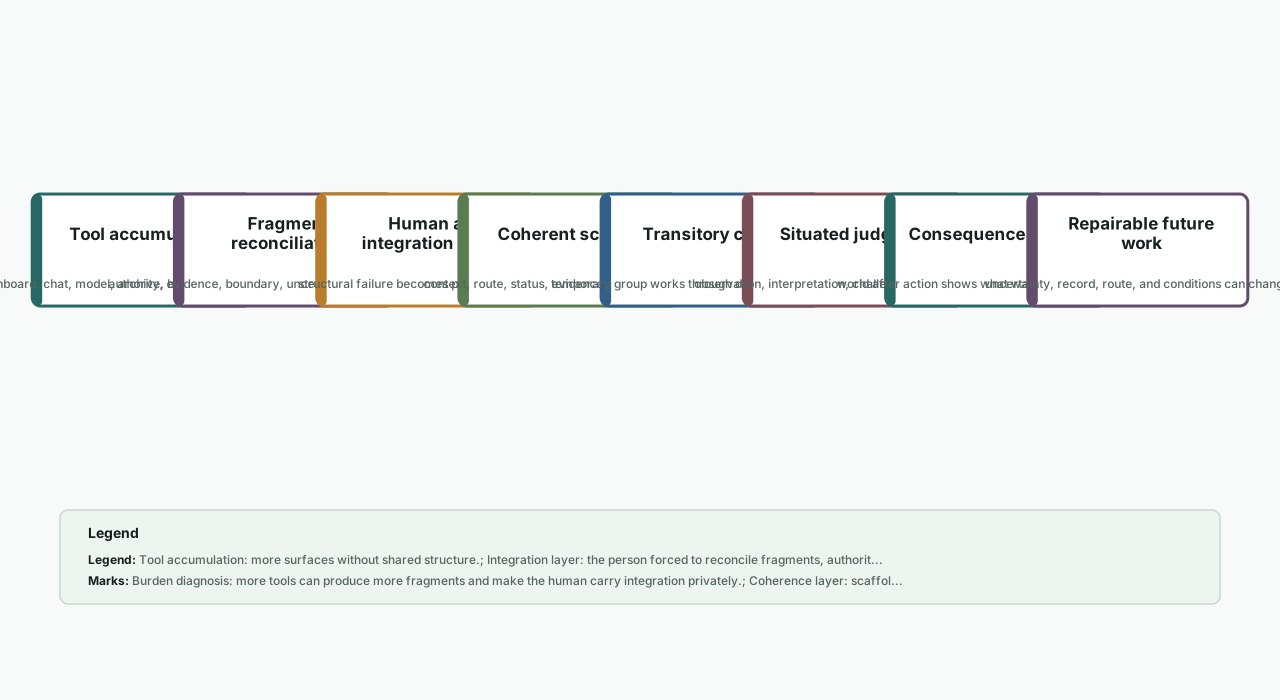
It is easy to confuse augmentation with tool accumulation.
Add a dashboard. Add a chat channel. Add a model. Add an archive. Add a workflow board. Add a transcript. Add a search layer. The organization now has more surfaces, more signals, and more ways to move work quickly.
But if those surfaces do not fit together, they can increase the burden they were supposed to relieve. The person now has to reconcile more fragments. The team has to decide which artifact has authority. The reviewer has to infer whether a record is evidence, interpretation, proposal, decision, or instruction. The next participant has to guess whether uncertainty was resolved or merely omitted.
This is why Structural Coherence matters. A coherent structure does not make every artifact heavy. It makes the relationship among artifacts legible. The metric does not pretend to be the whole situation. The transcript does not pretend to be interpretation. The model output does not pretend to be authorization. The decision note does not erase the unresolved question. Each part carries its proper load.
When the structure is coherent, people can use tools without becoming the glue that holds contradictory tools together.
When the structure is incoherent, the human becomes the integration layer. That may look like flexibility, but it usually means the organization has outsourced structural failure to personal endurance.
What Scaffolding Changes
Scaffolding changes where memory, route, evidence, and repair live.
In unsupported work, memory lives in a few people. Route lives in habit. Evidence lives in scattered files. Authority lives in status. Repair lives in apology, escalation, or unofficial cleanup.
In scaffolded work, those burdens become part of the shared environment. A record can show where it came from. A route can show what kind of step is being taken. A status marker can show whether the work is draft, reviewed, disputed, superseded, or released. A forum can interpret consequence without treating the record as a final verdict. A later participant can reconstruct enough of the situation to challenge or repair the artifact.
This does not remove judgment. It makes judgment less brittle.
The actor still has to notice what matters. The group still has to interpret. The forum still has to decide how to respond. The difference is that the environment is no longer asking everyone to pretend the support structure exists when it does not.
This is the quiet force of accountable scaffolding. It does not announce itself as intelligence. It gives people better conditions for responsible action.
Temporary Groups Need Durable Context
Many of the most important groups are temporary.
An incident team forms around a failure. A research group forms around a proposal. A review team forms around a model output. A classroom group forms around a project. A design group forms around a public artifact. The group is real, but it may not become a department, committee, or permanent office.
That is why the Field Guide uses the pattern of Transitory Cohorts.
A transitory cohort is a temporary, purpose-bounded group that coordinates through shared artifacts and support fields. Its members may change. Its work may dissolve, hand off, or reconfigure. What matters is that the state of the work does not disappear when the group changes shape.
Without scaffolding, temporary groups leave behind flattened remnants: a decision without its ecology, a recommendation without its warrant, a summary without its uncertainty, a handoff without its open questions. Later people inherit the artifact but not the situation.
With scaffolding, the cohort can leave a different kind of trace. The next person can see what signal entered, what interpretation was made, what action followed, what consequence returned, and what remains repairable. The artifact does not need to contain the entire world. It needs to preserve enough contact that the next responsible actor is not forced to choose between blind trust and total reinvestigation.
That is augmented agency at group scale. The group gains capacity because the work can outlive the room without losing its bearings.
Less Coercion, More Repair
The human outcome is not frictionless efficiency.
Frictionless systems often hide friction by displacing it. Someone still carries ambiguity. Someone still carries cleanup. Someone still absorbs the cost of a metric that does not fit the situation. Someone still has to explain why the official record missed the thing everyone privately knows.
Augmented agency does not remove friction. It gives friction an accountable place to appear.
A conflict can become a recorded uncertainty instead of a hallway rumor. A weak signal can remain provisional instead of becoming a decision because it was the only portable thing available. A model output can become a draft artifact instead of an authority surface. A consequence can be interpreted by a forum instead of being folded into a performance score without context.
This matters because coercion does not always arrive as a command. It often arrives as a work structure with no viable alternative. The form has no field for the relevant context. The dashboard has no way to show sensor conditions. The review process has no route for affected people to challenge the record. The handoff has no place for uncertainty. The team keeps moving because stopping would be expensive.
Augmented agency creates alternatives inside the structure. It gives the group ways to preserve context, mark uncertainty, challenge records, route repair, and keep action connected to consequence.
That is not utopian. It is basic engineering discipline applied to human coordination.
The Practical Image
Picture a temporary cohort reviewing a consequential recommendation.
The group does not begin with a blank conversation or a pile of disconnected files. It begins with a source packet, a bounded question, known constraints, prior interpretations, dissenting notes, and a visible release threshold. A model may assist. A dashboard may provide signals. A transcript may preserve conversation. But none of these artifacts is allowed to pretend to be the whole situation.
The cohort works through the artifact. It distinguishes observation from interpretation. It marks what is known, what is inferred, and what remains uncertain. It records who has standing to challenge the claim. It names the consequence that would indicate the recommendation was wrong or incomplete. It leaves a repair route for the next person who meets the situation after the group dissolves.
No one in that scene has become superhuman. No machine has become sovereign. The group is still finite, political, tired, and fallible.
But the work is less dependent on memory, status, and performance. The structure carries enough of the burden that people can spend more of their attention on situated judgment.
That is the field this guide has been moving toward.
Not more information for its own sake.
Not automation as spectacle.
Not a perfect organization.
A public method for building artifacts, routes, and temporary human groups that can keep contact with the situations they act upon.
Augmented agency is the name for the human capacity that appears when the scaffolding works.