InquirySpec - Narrative Arc: Bridge memory and context into coordinated action across human, machine, physical, and digital surfaces. - Paradigm Shift: The reader stops imagining a single intelligent center and starts seeing coordinated support fields. - Reader Exit State: The reader can describe why cyber-physical coordination requires routing, state, and responsibility boundaries.
Coordinating Action Across the Divide
A team can have the right people, the right documents, the right AI tools, and still fail at the moment action has to cross a boundary.
Someone summarizes the meeting. Someone opens a ticket. Someone asks a model to draft the next version. Someone remembers that legal objected last quarter, but not exactly why. Someone else knows the customer context, but that knowledge lives in a call transcript no one has time to read. The deadline moves closer, so the group picks the visible path: send the update, ship the draft, close the loop, mark the task done.
Nothing about this requires laziness. The failure is structural. Complex work moves through human attention, documents, chat threads, spreadsheets, models, permissions, review gates, and physical consequences. Every boundary changes the shape of the work. If the system does not preserve state, context, authority, and evidence as the work moves, the group is forced to coordinate by private inference.
Private inference is expensive. It asks each participant to reconstruct the whole situation from fragments. A human has to remember what happened before. A model has to infer unstated policy from a prompt. A manager has to decide whether a metric is a signal or an artifact of local friction. A reviewer has to guess whether an output is provisional, approved, obsolete, or merely fluent. Under pressure, everyone starts acting as if the nearest artifact carries more of the situation than it actually does.
This is the divide. It is not just the divide between human and machine. It is the divide between physical experience and digital signal, between local judgment and institutional authority, between provisional work and canonical state, between a record that exists and a record that is warranted for use.
The first move is to stop looking for one intelligent center.
The Wrong Center
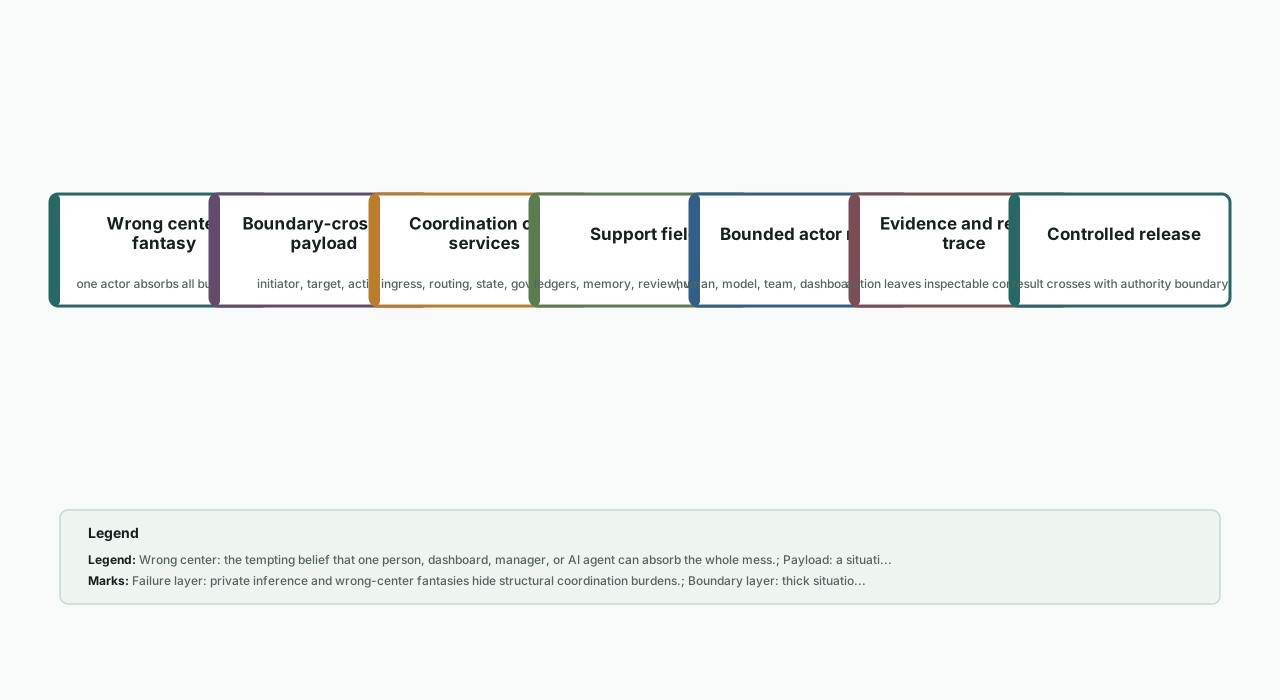
When coordination gets hard, the cultural reflex is to search for the entity that should own the whole problem. Sometimes that entity is a senior person. Sometimes it is a project manager. Sometimes it is a dashboard. Recently, it is often imagined as an autonomous AI agent: a system that can receive the goal, infer the plan, remember the context, apply the rules, execute the work, check itself, explain the outcome, and know when it is done.
That fantasy is attractive because it promises relief from coordination tax. It says the mess can be absorbed into a center.
But the mess is not only cognitive. It is structural. The work has different kinds of burdens. Receiving a request is not the same as knowing the current state. Knowing the current state is not the same as applying governance. Applying governance is not the same as retrieving memory. Retrieving memory is not the same as executing a bounded action. Executing an action is not the same as releasing an accountable artifact.
When those burdens are loaded onto one actor, the actor may look powerful for a while. In practice, the system becomes fragile. It becomes easier for state to drift, for old assumptions to return, for a plausible sentence to pass as a valid next step, for a temporary output to become canonical, or for a human forum to inherit a decision no one actually authorized.
Coordination Core names the alternative. Coordination is not a personality trait. It is a service responsibility. Serious work needs controlled ingress, process routing, state orientation, governance, memory, verification, and controlled release. Those words can sound dry until you notice what happens when they are missing.
Without controlled ingress, everything enters as if it were equally actionable. A complaint, a proposal, a transcript, a model output, and a policy exception all hit the same channel.
Without state orientation, participants solve the wrong version of the problem.
Without governance, the group cannot tell the difference between "can be generated" and "is allowed to move."
Without memory, context lives inside the person most exhausted by being asked to remember it.
Without controlled release, drafts, summaries, and decisions leak into the world with unclear authority.
Coordination begins when those burdens stop hiding inside people.
The Boundary Changes the Work
Digital systems do not receive reality directly. They receive payloads.
A person may experience a situation as a thick, time-bound ecology: tone of voice, prior promises, local constraints, institutional fear, fatigue, weather, budget, trust, ambiguity, and consequences that will land unevenly on different people. But when that situation crosses into a digital system, it has to become something discrete. A message. A form field. A ticket. A commit. A transcript. A prompt. A record.
The Digitality Interaction doctrine gives this a strict shape: an interaction must become an Initiator - Target - Action payload before the engine can route it. Publicly, the lesson is simple. A digital action needs to know who or what initiated it, what it is acting upon, and what kind of action is being attempted.
That translation is not a defect. It is how cyber-physical work becomes computable. A thermometer does not carry the whole room. It carries a number produced by a sensor in a location under specific conditions. The number is useful because the system knows how it was produced, where it came from, and what it is allowed to mean.
The same is true for knowledge work. A dashboard value, a meeting note, a model summary, or a status flag can be useful if the system preserves enough of the sensor ecology around it. Who produced it? Under what constraint? Against which target? With what authority? As what kind of action? For which downstream use?
The danger is not that the payload is one-dimensional. The danger is reading it as if it were the whole situation.
This is why coordination across the divide requires routing. A payload that should be treated as an observation must not become a decision merely because it is cleanly formatted. A generated summary must not become institutional memory merely because it is fluent. A provisional artifact must not become a release artifact because it sits in the same folder. A human judgment must not be replaced by a machine trace, and a machine trace must not be ignored when a human forum needs evidence.
The boundary changes the work. A mature system records the crossing.
Support Fields, Not Sovereign Agents
The Workflow Engine exists because coordinated action needs a field around the actor.
That field is not a manager standing above the work. It is a set of burden-bearing structures around the work: ledgers, state files, selectors, archive routines, verification scripts, review gates, memory links, and human veto points. Some are technical. Some are social. Some are procedural. Together, they prevent the system from pretending that one participant has the whole situation inside their head.
This is the heart of Supported Agency. The actor still acts. The human still judges. The model still generates or transforms. The team still interprets. But the actor is not asked to carry every burden that makes the action accountable.
Good support fields feel almost boring. They answer ordinary questions:
- What entered the workflow?
- What state was the work in when it entered?
- Which rule or boundary applies?
- Which context may be restored?
- What action is actually being taken?
- What evidence did the action leave?
- Who or what may release the result?
- Where does repair route if the action fails?
These questions are not bureaucracy for its own sake. They are the minimum viable structure for acting across boundaries without hallucinating coherence.
A human can be compassionate and still misremember. A model can be fluent and still lack authority. A team can be aligned and still lose state. A dashboard can be precise and still omit the local friction that produced the number. Coordination infrastructure exists because every participant is bounded.
The point is not to slow action until it becomes safe in the abstract. The point is to make action bounded enough that speed does not erase responsibility.
A Small Example
Imagine a support team facing a spike in unresolved tickets. The dashboard shows a number moving in the wrong direction. A manager asks for an explanation. A model summarizes the ticket data and says the team is falling behind because response quality has declined. The simplest response is to pressure the team to move faster.
But the number is not the situation.
A coordination-aware workflow asks what kind of payload the dashboard value is. It is an observation, not a judgment. It asks what target the model acted on. Did it read only ticket metadata, or did it also receive staffing changes, product defects, customer segmentation, and policy exceptions? It asks what state the team was in. Was there a release incident? A training gap? A hidden dependency on another group? It asks which governance boundary applies. Is this performance review, operational triage, product feedback, or customer harm mitigation?
None of these questions require accusing anyone of bad intent. They are how the system resists systemic gravity. The pressure to act quickly is real. The desire for a single clean explanation is real. The metabolic cost of reading the whole ecology is real. The coordination field exists so the group does not have to choose between paralysis and flattened action.
A better workflow might route the dashboard number as an intake signal, attach the model summary as a provisional interpretation, restore relevant context from memory, require a human review forum for consequence-bearing action, and release a bounded next step: investigate the product defect cluster before changing team performance expectations.
The result is not perfect knowledge. It is accountable movement.
What This Changes
Once you see coordination as a support field, human-AI work looks different.
You stop asking whether the AI is smart enough to own the workflow. You ask whether the workflow gives the AI a bounded role, authorized context, clear target, and reviewable output.
You stop asking whether the human remembered everything. You ask whether the system preserved the state the human needed.
You stop asking whether the dashboard is accurate in isolation. You ask what sensor ecology produced the signal and what it is warranted to trigger.
You stop treating a handoff as a message and start treating it as a boundary crossing.
This is the practical bridge from context to action. Earlier Field Guide essays argued that information is not enough, that digital signals require context, and that retrieval is not authority. This essay adds the operational consequence: once context is restored, it still has to move. Movement requires routing. Routing requires state. State requires memory. Memory requires governance. Governance requires human forums that can distinguish evidence from judgment.
The divide will not disappear. It is built into cyber-physical work. People live in time, bodies, institutions, and relationships. Machines receive discrete payloads and operate through formal boundaries. Documents preserve some things and omit others. Models transform signals and produce new artifacts. Institutions decide which artifacts count.
The design question is whether the crossing is structured enough to remain accountable.
Coordinated action begins when the system can say: this is what crossed, this is the state it entered, this is the rule that governed it, this is the context restored, this is the action taken, this is the evidence left, and this is the boundary through which the result was released.
That is not the end of judgment. It is what makes judgment possible under modern conditions.