InquirySpec - Ontological Boundary: Reflexive Dialogic Inquiry is the bounded inquiry practice by which human and machine collaborators keep conversation, artifact, and consequence in reciprocal contact. - Not This: Not generic collaboration, vague humility theater, stakeholder performance, or an excuse to avoid artifact production. - Doctrine Dependencies: Design-Based Research, Observation-Interpretation-Application, Reality-Contact, Pathway to Incompleteness.
Working Definition
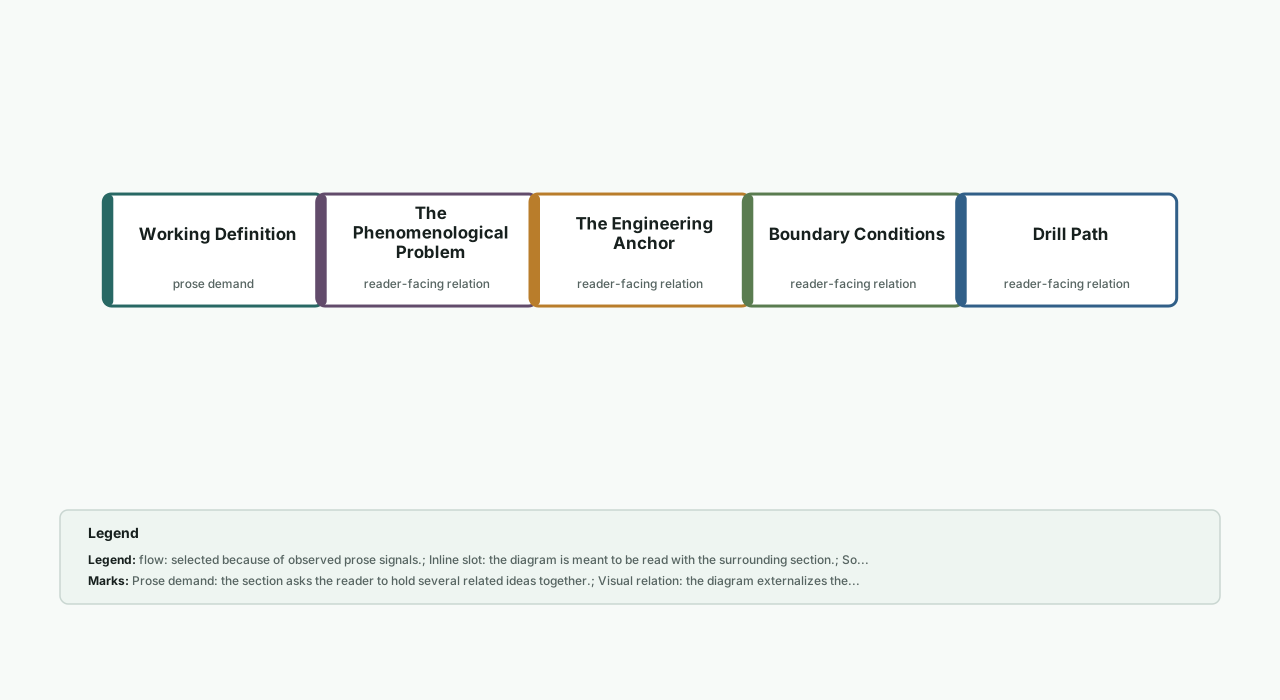
Reflexive Dialogic Inquiry is the method for keeping inquiry, artifact, and consequence in conversation while people and AI systems work together. It does not treat dialogue as a layer floating above the work. It requires conversation to leave artifacts that can be inspected, challenged, revised, and carried forward.
The practice is reflexive because participants examine the frames that shape their observations: assumptions, tool affordances, institutional pressures, missing evidence, role boundaries, and prior doctrine. It is dialogic because no single viewpoint gets to close the loop alone. It is inquiry because each output remains answerable to the next encounter with reality.
For the Field Guide, this concept names the metabolism of the whole project. Inquiry becomes an artifact. The artifact meets use, constraint, disagreement, and breakdown. Those encounters revise the next inquiry. The point is not to keep everything perpetually open; the point is to close work in a way that leaves a path back into learning.
The Phenomenological Problem
Knowledge work tends to reward closure before interpretation is actually complete. A document is approved. A dashboard turns green. A meeting produces alignment. An AI summary sounds fluent. A category stabilizes. None of these signals are inherently false, but each can become a substitute for the harder question: what did we observe, how did we interpret it, what changed, and what remains unresolved?
This is not a failure of character. It is systemic gravity. Continuing interpretation has a cost: time, context, dissent, version history, and delayed release. Under throughput pressure, teams often accept the completed-looking artifact because the alternative requires a slower social and technical loop. AI can intensify the pattern by making thin interpretation read as if it already has shape.
Reflexive Dialogic Inquiry exists to resist closure theater without turning every decision into endless discussion. It gives teams a disciplined way to ask what the artifact is carrying, what it is hiding, and what future contact will be allowed to revise.
The Engineering Anchor
The engineering anchor is Observation, Interpretation, and Application. Observation must preserve contact with what happened. Interpretation must make meaning without pretending that meaning is automatic. Application must alter an artifact, decision, workflow, or next experiment in a way that can be inspected later.
In that sense, Reflexive Dialogic Inquiry is a controlled feedback interface. It is not private reflection, and it is not an unbounded conversation. It needs records, roles, review surfaces, and a pathway to incompleteness. A claim made in dialogue should have a place to land. A change made to an artifact should have a reason. A later consequence should have a way to reopen the interpretation without erasing the prior state.
The meta-model behind learnt.cloud treats the Field Guide, specs, tooling, and observed use as a reciprocal system. Reflexive Dialogic Inquiry is the practice that keeps those layers from drifting apart. It turns conversation into a reviewable record, and it returns records to conversation when the world pushes back.
Boundary Conditions
Reflexive Dialogic Inquiry is not the same as brainstorming, stakeholder management, meeting facilitation, or model critique. Those activities can participate in it, but they are not sufficient by themselves.
The practice fails when dialogue does not change the artifact, when artifacts cannot be challenged, when AI fluency substitutes for review, or when participation has no consequence. It also fails when the method demands that every person participate in every decision. Bounded inquiry matters: the right observers, the right records, the right interpretation forum, and the right handoff are often more important than maximum participation.
The cleanest test is simple: can someone later inspect what was observed, what was interpreted, what changed, and why the remaining incompleteness was acceptable at the time? If not, the inquiry may have produced conversation, but it has not produced an accountable learning surface.
Drill Path
- Use Design-Based Research when inquiry needs to become an iterative intervention rather than a detached analysis.
- Use Observation-Interpretation-Application when the learning loop needs a disciplined sequence from contact to meaning to movement.
- Use Reality-Contact when an artifact needs to stay answerable to consequences beyond its own polished form.
Field questions:
- What did this artifact make easier to observe?
- What interpretation did the dialogue expose, revise, or leave incomplete?
- What changed in the artifact because of that interpretation?
- Who can challenge the interpretation later, and where would that challenge land?
- What future consequence will tell us whether the current closure was sufficient?